LEB 320F FINAL EXAM ACTUAL 2025/2026 CORRECTLY ANSWERED
Course:
LEB 320F
Institution:
LEB 320F
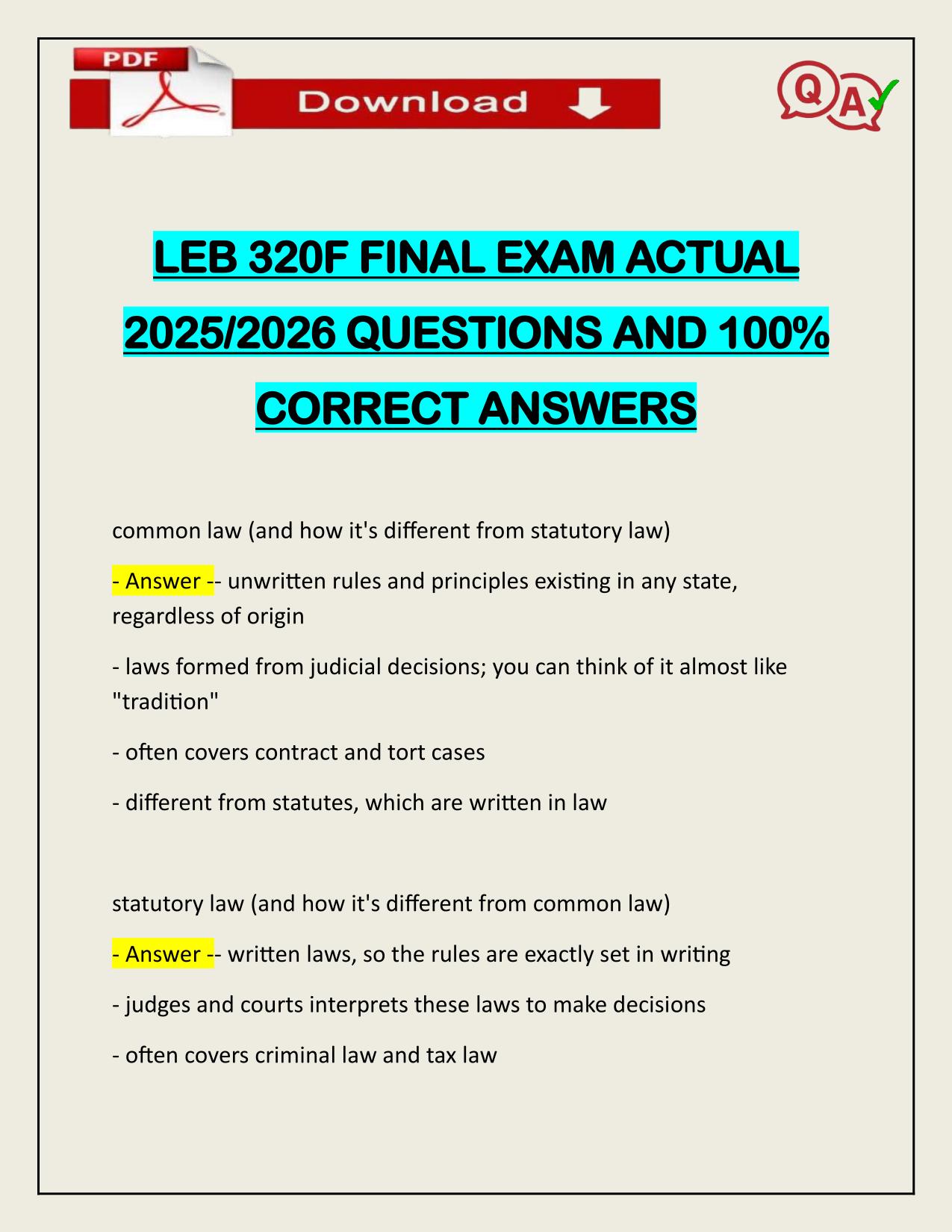
LEB 320F FINAL EXAM ACTUAL 2025/2026 QUESTIONS AND 100% CORRECT ANSWERS common law (and how it's different from statutory law) - Answer -- unwritten rules and principles existing in any state, regardless of origin - laws formed from judicial decision...
After purchase, you get:
✅ Instant PDF Download
✅ Verified answer explanations
✅ Refund if not Satisfied
✅ Prepared for 2025/2026 test cycle
Overview
Learners gain valuable practice with question types commonly used on official LEB 320F FINAL ACTUAL / CORRECTLY ANSWERED exams. From multiple-choice to case studies, you'll encounter the full range of formats used in actual assessments. This complete exposure prevents surprises on test day and builds adaptability in your approach. Students often mention how this variety keeps their study sessions interesting and engaging over weeks of preparation.
Who Is This For?
Suitable for academic programs, tutoring sessions, and exam bootcamps focusing on LEB 320F and Exam (elaborations) fundamentals. Educators find it saves them preparation time while ensuring quality content. The material adapts well to different teaching environments.
Related Keywords
Detailed Study Description
Frequently Asked Questions
Document Information
| Uploaded on: | October 31, 2025 |
| Last updated: | November 17, 2025 |
| Number of pages: | 74 |
| Written in: | 2025/2026 |
| Type: | Exam (elaborations) |
| Contains: | Questions & Answers |
| Tags: | LEB 320F FINAL EXAM ACTUAL 2025/2026 QUESTIONS AND 100% CORRECT ANSWERS common law (and how it's different from statutory law) - Answer -- unwritten rules and principles existing in any state, regardless of origin - laws formed from judicial decisions; you can think of it almost like "tradition" - often covers contract and tort cases - different from statutes, which are written in law |
Seller Information

AdelineJean
User Reviews (0)
Exam (Elaborations)
$10.00
Add to Cart
100% satisfaction guarantee
Refund Upon dissatisfaction
Immediately available after purchase
Available in Both online and PDF
$10.00
| 0 sold
Discover More resources
Inside The Document
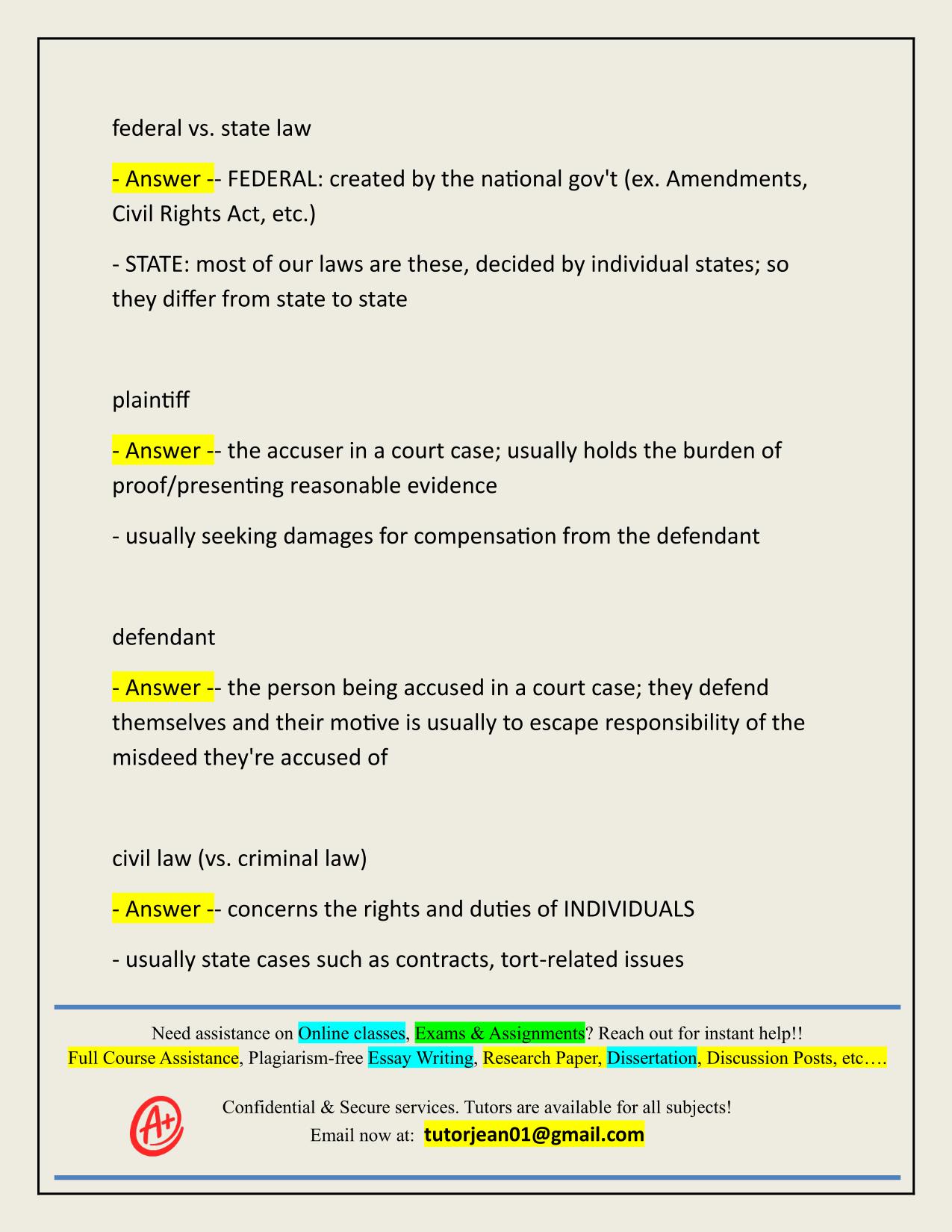
LEB 320F FINAL EXAM ACTUAL 2025/2026 QUESTIONS AND 100% CORRECT ANSWERS common law (and how it's different from statutory law) - Answer -- unwritten rules and principles existing in any state, regardless of origin - laws formed from judicial decisions; you can think of it almost like "tradition" - often covers contract and tort cases - different from statutes, which are written in law statutory law (and how it's different from common law) - Answer -- written laws, so the rules are exactly set in writing - judges and courts interprets these laws to make decisions - often covers criminal law and tax law federal vs. state law - Answer -- FEDERAL: created by the national gov't (ex. Amendments, Civil Rights Act, etc.) - STATE: most of our laws are these, decided by individual states; so they differ from state to state plaintiff - Answer -- the accuser in a court case; usually holds the burden of proof/presenting reasonable evidence - usually seeking damages for compensation from the defendant defendant - Answer -- the person being accused in a court case; they defend themselves and their motive is usually to escape responsibility of the misdeed they're accused of civil law (vs. criminal law) - Answer -- concerns the rights and duties of INDIVIDUALS - usually state cases such as contracts, tort-related issues Need assistance on Online classes, Exams & Assignments? Reach out for instant help!! Full Course Assistance, Plagiarism-free Essay Writing, Research Paper, Dissertation, Discussion Posts, etc…. Confidential & Secure services. Tutors are available for all subjects! Email now at: tutorjean01@gmail.com - in these cases, plaintiff only needs to prove their case by a preponderance of the evidence (as in it's somewhat more believable than defendant's case) - cases are named as [entity/individual] v. [entity/individual] criminal law (vs. civil law); what kind of punishment does wrongdoer face? - Answer -- usually on a federal level; criminal law determines that the defendant's wrongdoing counts against the entire society as a whole - in contrast to civil cases, plaintiff here must prove beyond a reasonable doubt - wrongdoer usually has to pay BOTH the civil and criminal penalties; ex. go to jail AND pay damages - cases are named [entity/individual] v. [gov't] laws - Answer -rules that must be followed ethics (and why it has to do with law) - Answer -- standards we set for ourselves to be morally correct; does not directly have legal consequences though - ethics often affect what laws we make; ex. we allow minors to back out of sales contracts even though the seller may not have taken advantage of them in any way Laws must be... (4 things) - Answer -- relatively certain (so people can trust each other not to break the law) - relatively flexible - known or knowable (so lawyers can recommend things with accuracy) - apparently reasonable state courts (3 types and their scope of cases) - Answer -- Courts of LIMITED JURISDICTION: many many of these courts b/c most cases classify here; only hears specific types of cases such as traffic, justice of the peace, municipal (city/town), and domestic relations - GENERAL TRIAL courts: aka general jurisdiction aka district courts aka superior courts; can hear all cases except the ones expressly assigned to limited juris.; cases generally all originate in this court, then may move on to appellate courts; usually one in every county Need assistance on Online classes, Exams & Assignments? Reach out for instant help!! Full Course Assistance, Plagiarism-free Essay Writing, Research Paper, Dissertation, Discussion Posts, etc…. Confidential & Secure services. Tutors are available for all subjects! Email now at: tutorjean01@gmail.com
CourseHero & Studypool Unlocks
Get Unlocked CourseHero and Studypool documents files instantly to your email, simply by pasting your link and clicking "Unlock Now". Learn more on how to unlock here.

Gradesity

We are here to help
Questions? Leave a message!
Newsletter
Get notified upon new uploads. Subscribe to our Newsletter.