Test Bank Concepts for Nursing Practice (3rd Ed) by Jean Giddens ISBN 9780323581936 ALL CHAPTERS
Course:
Nursing Practice
Institution:
Nursing Practice
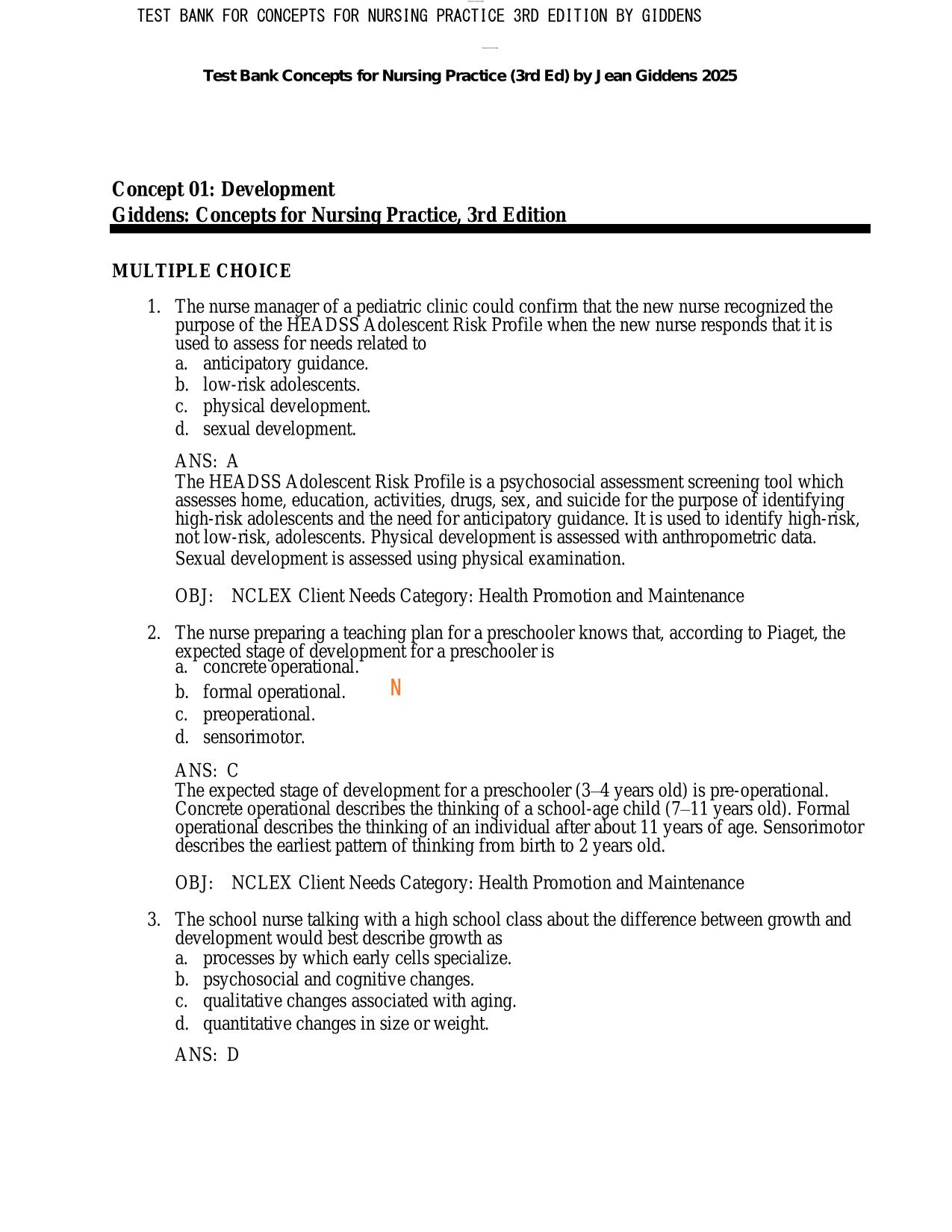
Test Bank Concepts for Nursing Practice (3rd Ed) by Jean Giddens ISBN 9780323581936 ALL CHAPTERS MULTIPLE CHOICE 1. The nurse manager of a pediatric clinic could confirm that the new nurse recognized the purpose of the HEADSS Adolescent Risk Profile ...
After purchase, you get:
✅ Instant PDF Download
✅ Verified answer explanations
✅ Refund if not Satisfied
✅ Prepared for 2025/2026 test cycle
Overview
Detailed answer keys help users track progress, address weak spots, and practice under timed conditions. The immediate feedback lets you catch misunderstandings before they become bad habits that are hard to break. Students frequently use these keys to map out their study priorities based on actual performance rather than guesswork. Being able to see exactly where you need improvement turns random studying into a strategic, focused effort that delivers real results.
Who Is This For?
Useful for last-minute revision or long-term study plans, especially for those tackling Bank Concepts for Nursing Practice (3rd Ed) by Jean Giddens ISBN 9780323581936 ALL CHAPTERS or similar certification paths. Many users keep it bookmarked for quick reference during study sessions. The practical format works well for different study approaches.
Related Keywords
Detailed Study Description
Frequently Asked Questions
Document Information
| Uploaded on: | November 1, 2025 |
| Last updated: | November 26, 2025 |
| Number of pages: | 199 |
| Written in: | 2025/2026 |
| Type: | Exam (elaborations) |
| Contains: | Questions & Answers |
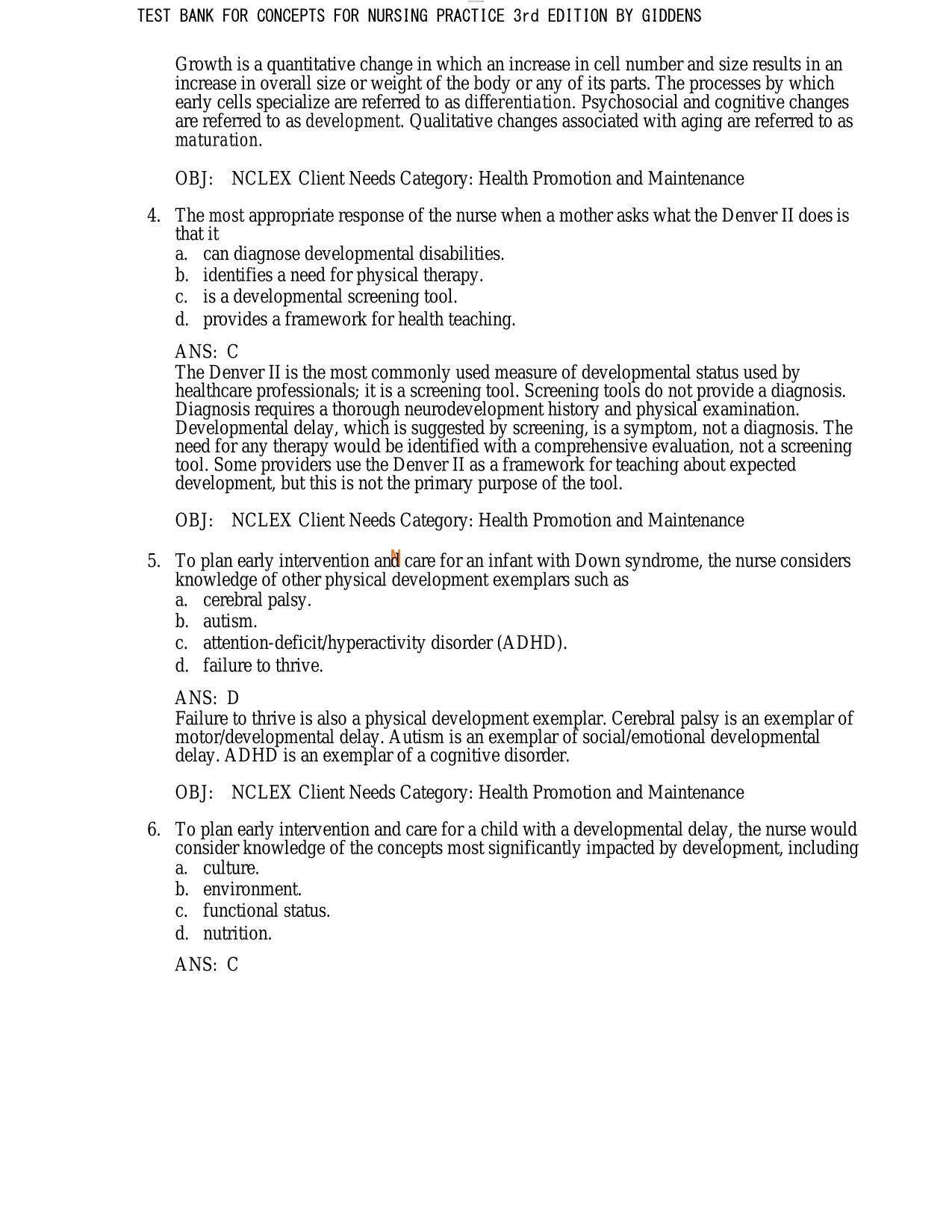
| Tags: | Test Bank Concepts for Nursing Practice (3rd Ed) by Jean Giddens ISBN 9780323581936 ALL CHAPTERS MULTIPLE CHOICE 1. The nurse manager of a pediatric clinic could confirm that the new nurse recognized the purpose of the HEADSS Adolescent Risk Profile when the new nurse responds that it is used to assess for needs related to a. anticipatory guidance. b. low-risk adolescents. c. physical development. d. sexual development. ANS: A The HEADSS Adolescent Risk Profile is a psychosocial assessment screening tool which assesses home, education, activities, drugs, sex, and suicide for the purpose of identifying high-risk adolescents and the need for anticipatory guidance. It is used to identify high-risk, not low-risk, adolescents. Physical development is assessed with anthropometric data. Sexual development is assessed using physical examination. OBJ: NCLEX Client Needs Category: Health Promotion and Maintenance 2. The nurse preparing a teaching plan for a preschooler knows that, according to Piaget, the expected stage of development for a preschooler is a. concrete operational. b. formal operational. N c. preoperational. d. sensorimotor. ANS: C The expected stage of development for a preschooler (3–4 years old) is pre-operational. Concrete operational describes the thinking of a school-age child (7–11 years old). Formal operational describes the thinking of an individual after about 11 years of age. Sensorimotor describes the earliest pattern of thinking from birth to 2 years old. OBJ: NCLEX Client Needs Category: Health Promotion and Maintenance 3. The school nurse talking with a high school class about the difference between growth and development would best describe growth as a. processes by which early cells specializ |
Seller Information

AdelineJean
User Reviews (0)
Exam (Elaborations)
$17.00
Add to Cart
100% satisfaction guarantee
Refund Upon dissatisfaction
Immediately available after purchase
Available in Both online and PDF
$17.00
| 0 sold
Discover More resources
Inside The Document
lOMoAR cPSD| 3013804 TEST BANK FOR CONCEPTS FOR NURSING PRACTICE 3RD EDITION BY GIDDENS lOMoAR cPSD| 3013804 Test Bank Concepts for Nursing Practice (3rd Ed) by Jean Giddens 2025 Concept 01: Development Giddens: Concepts for Nursing Practice, 3rd Edition MULTIPLE CHOICE 1. The nurse manager of a pediatric clinic could confirm that the new nurse recognized the purpose of the HEADSS Adolescent Risk Profile when the new nurse responds that it is used to assess for needs related to a. anticipatory guidance. b. low-risk adolescents. c. physical development. d. sexual development. ANS: A The HEADSS Adolescent Risk Profile is a psychosocial assessment screening tool which assesses home, education, activities, drugs, sex, and suicide for the purpose of identifying high-risk adolescents and the need for anticipatory guidance. It is used to identify high-risk, not low-risk, adolescents. Physical development is assessed with anthropometric data. Sexual development is assessed using physical examination. OBJ: NCLEX Client Needs Category: Health Promotion and Maintenance 2. The nurse preparing a teaching plan for a preschooler knows that, according to Piaget, the expected stage of development for a preschooler is a. concrete operational. N b. formal operational. c. preoperational. d. sensorimotor. ANS: C The expected stage of development for a preschooler (3–4 years old) is pre-operational. Concrete operational describes the thinking of a school-age child (7–11 years old). Formal operational describes the thinking of an individual after about 11 years of age. Sensorimotor describes the earliest pattern of thinking from birth to 2 years old. OBJ: NCLEX Client Needs Category: Health Promotion and Maintenance 3. The school nurse talking with a high school class about the difference between growth and development would best describe growth as a. processes by which early cells specialize. b. psychosocial and cognitive changes. c. qualitative changes associated with aging. d. quantitative changes in size or weight. ANS: D lOMoAR cPSD| 3013804 TEST BANK FOR CONCEPTS FOR NURSING PRACTICE 3rd EDITION BY GIDDENS Growth is a quantitative change in which an increase in cell number and size results in an increase in overall size or weight of the body or any of its parts. The processes by which early cells specialize are referred to as differentiation. Psychosocial and cognitive changes are referred to as development. Qualitative changes associated with aging are referred to as maturation. OBJ: NCLEX Client Needs Category: Health Promotion and Maintenance 4. The most appropriate response of the nurse when a mother asks what the Denver II does is that it a. can diagnose developmental disabilities. b. identifies a need for physical therapy. c. is a developmental screening tool. d. provides a framework for health teaching. ANS: C The Denver II is the most commonly used measure of developmental status used by healthcare professionals; it is a screening tool. Screening tools do not provide a diagnosis. Diagnosis requires a thorough neurodevelopment history and physical examination. Developmental delay, which is suggested by screening, is a symptom, not a diagnosis. The need for any therapy would be identified with a comprehensive evaluation, not a screening tool. Some providers use the Denver II as a framework for teaching about expected development, but this is not the primary purpose of the tool. OBJ: NCLEX Client Needs Category: Health Promotion and Maintenance 5. To plan early intervention anN d care for an infant with Down syndrome, the nurse considers knowledge of other physical development exemplars such as a. cerebral palsy. b. autism. c. attention-deficit/hyperactivity disorder (ADHD). d. failure to thrive. ANS: D Failure to thrive is also a physical development exemplar. Cerebral palsy is an exemplar of motor/developmental delay. Autism is an exemplar of social/emotional developmental delay. ADHD is an exemplar of a cognitive disorder. OBJ: NCLEX Client Needs Category: Health Promotion and Maintenance 6. To plan early intervention and care for a child with a developmental delay, the nurse would consider knowledge of the concepts most significantly impacted by development, including a. culture. b. environment. c. functional status. d. nutrition. ANS: C lOMoAR cPSD| 3013804 TEST BANK FOR CONCEPTS FOR NURSING PRACTICE 3RD EDITION BY GIDDENS Function is one of the concepts most significantly impacted by development. Others include sensory-perceptual, cognition, mobility, reproduction, and sexuality. Knowledge of these concepts can help the nurse anticipate areas that need to be addressed. Culture is a concept that is considered to significantly affect development; the difference is the concepts that affect development are those that represent major influencing factors (causes); hence determination of development would be the focus of preventive interventions. Environment is considered to significantly affect development. Nutrition is considered to significantly affect development. OBJ: NCLEX Client Needs Category: Health Promotion and Maintenance 7. A mother complains to the nurse at the pediatric clinic that her 4-year-old child always talks to her toys and makes up stories. The mother wants her child to have a psychological evaluation. The nurse’s best initial response is to a. refer the child to a psychologist immediately. b. explain that playing make believe is normal at this age. c. complete a developmental screening using a validated tool. d. separate the child from the mother to get more information. ANS: B By the end of the fourth year, it is expected that a child will engage in fantasy, so this is normal at this age. A referral to a psychologist would be premature based only on the complaint of the mother. Completing a developmental screening would be very appropriate but not the initial response. The nurse would certainly want to get more information, but separating the child from the mother is not necessary at this time. OBJ: NCLEX Client NeedsNCategory: Health Promotion and Maintenance 8. A 17-year-old girl is hospitalized for appendicitis, and her mother asks the nurse why she is so needy and acting like a child. The best response of the nurse is that in the hospital, adolescents a. have separation anxiety. b. rebel against rules. c. regress because of stress. d. want to know everything. ANS: C Regression to an earlier stage of development is a common response to stress. Separation anxiety is most common in infants and toddlers. Rebellion against hospital rules is usually not an issue if the adolescent understands the rules and would not create childlike behaviors. An adolescent may want to <know everything= with their logical thinking and deductive reasoning, but that would not explain why they would act like a child. OBJ: NCLEX Client Needs Category: Health Promotion and Maintenance lOMoAR cPSD| 3013804 TEST BANK FOR CONCEPTS FOR NURSING PRACTICE 3rd EDITION BY GIDDENS Concept 02: Functional Ability Giddens: Concepts for Nursing Practice, 3rd Edition MULTIPLE CHOICE 1. The nurse is assessing a patient’s functional ability. Which patient best demonstrates the definition of functional ability? a. Considers self as a healthy individual; uses cane for stability b. College educated; travels frequently; can balance a checkbook c. Works out daily, reads well, cooks, and cleans house on the weekends d. Healthy individual, volunteers at church, works part time, takes care of family and house ANS: D Functional ability refers to the individual’s ability to perform the normal daily activities required to meet basic needs; fulfill usual roles in the family, workplace, and community; and maintain health and well-being. The other options are good; however, healthy individual, church volunteer, part time worker, and the patient who takes care of the family and house fully meets the criteria for functional ability. OBJ: NCLEX Client Needs Category: Physiological Integrity: Basic Care and Comfort 2. The nurse is assessing a patient’s functional performance. What assessment parameters will be most important in this assessment? a. Continence assessment, gait assessment, feeding assessment, dressing assessment, N transfer assessment b. Height, weight, body mass index (BMI), vital signs assessment c. Sleep assessment, energy assessment, memory assessment, concentration assessment d. Health and well-being, amount of community volunteer time, working outside the home, and ability to care for family and house ANS: A Functional impairment, disability, or handicap refers to varying degrees of an individual’s inability to perform the tasks required to complete normal life activities without assistance. Height, weight, BMI, and vital signs are part of a physical assessment. Sleep, energy, memory, and concentration are part of a depression screening. Healthy, volunteering, working, and caring for family and house are functional abilities, not performance. OBJ: NCLEX Client Needs Category: Physiological Integrity: Reduction of Risk Potential 3. The nurse is assessing a patient with a mobility dysfunction and wants to gain insight into the patient’s functional ability. What question would be the most appropriate? a. <Are you able to shop for yourself?= b. <Do you use a cane, walker, or wheelchair to ambulate?= c. <Do you know what today’s date is?= d. <Were you sad or depressed more than once in the last 3 days?= ANS: B
CourseHero & Studypool Unlocks
Get Unlocked CourseHero and Studypool documents files instantly to your email, simply by pasting your link and clicking "Unlock Now". Learn more on how to unlock here.

Gradesity

We are here to help
Questions? Leave a message!
Newsletter
Get notified upon new uploads. Subscribe to our Newsletter.