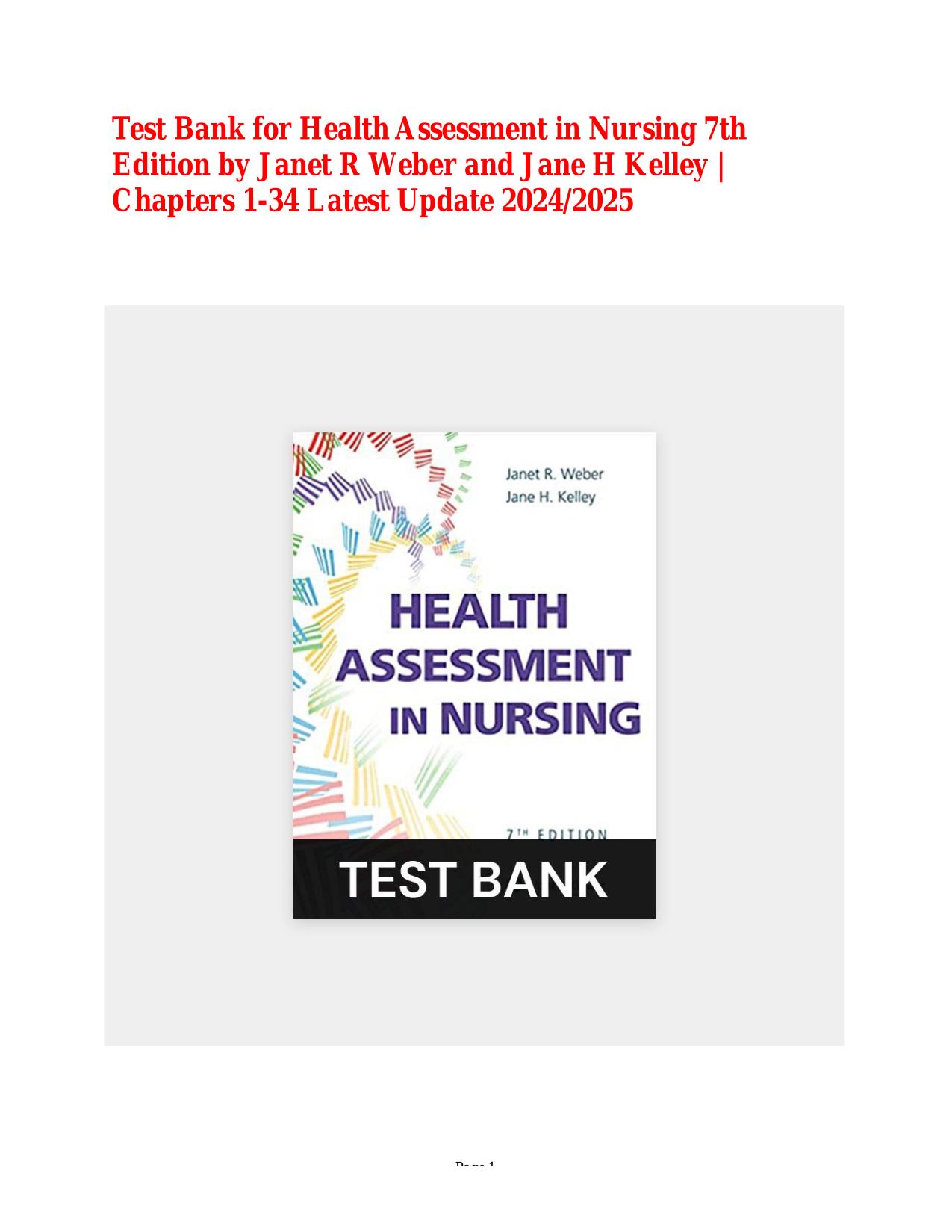
Test Bank for Health Assessment in Nursing 7th Edition by Janet R Weber & Jane H Kelley ISBN 9781975172572 | 34 Chapters
Course:
Health Assessment
Institution:
Health Assessment
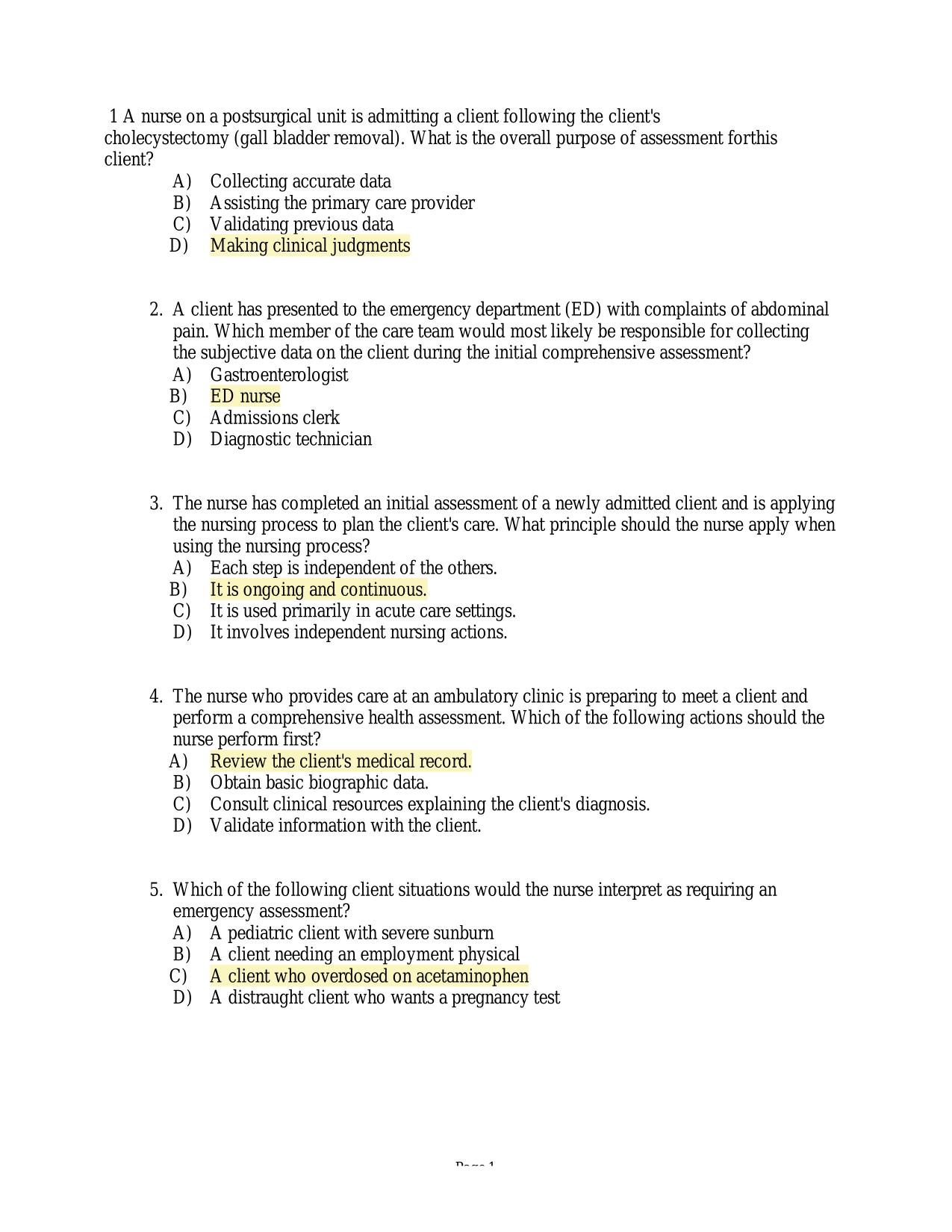
Test Bank for Health Assessment in Nursing 7th Edition by Janet R Weber & Jane H Kelley ISBN 9781975172572 | 34 Chapters 1 A nurse on a postsurgical unit is admitting a client following the client's cholecystectomy (gall bladder removal). What is the...
After purchase, you get:
✅ Instant PDF Download
✅ Verified answer explanations
✅ Refund if not Satisfied
✅ Prepared for 2025/2026 test cycle
Overview
Breakdown notes throughout the content provide additional context to support complex reasoning. These helpful asides offer deeper insight into why certain approaches work better than others. The extra context often makes challenging concepts click in ways that simplified explanations can't achieve. Many learners find these notes provide exactly the missing piece they needed to fully understand difficult topics.
Who Is This For?
Ideal for students, instructors and professionals preparing for Bank for Health Assessment in Nursing 7th Edition by Janet R Weber & Jane H Kelley ISBN 9781975172572 | 34 Chapters and related Health Assessment exams. Many learners find this format helps them identify knowledge gaps quickly. The material works well for both individual study and classroom settings. Perfect for busy learners seeking an streamlined, exam-focused study aid in Health Assessment. Many working professionals find it fits well into their hectic schedules. The focused content helps maximize study sessions, even when time is limited.
Related Keywords
Detailed Study Description
Frequently Asked Questions
Document Information
| Uploaded on: | November 1, 2025 |
| Last updated: | November 17, 2025 |
| Number of pages: | 262 |
| Written in: | 2025/2026 |
| Type: | Exam (elaborations) |
| Contains: | Questions & Answers |
| Tags: | Test Bank for Health Assessment in Nursing 7th Edition by Janet R Weber & Jane H Kelley ISBN 9781975172572 | 34 Chapters 1 A nurse on a postsurgical unit is admitting a client following the client's cholecystectomy (gall bladder removal). What is the overall purpose of assessment forthis client? A) Collecting accurate data B) Assisting the primary care provider C) Validating previous data D) Making clinical judgments 2. A client has presented to the emergency department (ED) with complaints of abdominal pain. Which member of the care team would most likely be responsible for collecting the subjective data on the client during the initial comprehensive assessment? A) Gastroenterologist B) ED nurse C) Admissions clerk D) Diagnostic technician 3. The nurse has completed an initial assessment of a newly admitted client and is applying the nursing process to plan the client's care. What principle should the nurse apply when using the nursing process? A) Each step is independent of the others. B) It is ongoing and continuous. C) It is used primarily in acute care settings. D) It involves independent nursing actions. 4. The nurse who provides care at an ambulatory clinic is preparing to meet a client and perform a comprehensive health assessment. Which of the following actions should the nurse perform first? A) Review the client's medical record. B) Obtain basic biographic data. C) Consult clinical resources explaining the client's diagnosis. D) Validate information with the client. 5. Which of the following client situations would the nurse interpret as requiring an emergency assessment? A) A pediatric client with severe sunburn B) A client needing an employment physical C) A client who overdosed on acetaminophen D) A distraught client who wants a pregnancy tes |
Seller Information

AdelineJean
User Reviews (0)
Exam (Elaborations)
$17.50
Add to Cart
100% satisfaction guarantee
Refund Upon dissatisfaction
Immediately available after purchase
Available in Both online and PDF
$17.50
| 0 sold
Discover More resources
Inside The Document
Test Bank for Health Assessment in Nursing 7th Edition by Janet R Weber and Jane H Kelley | Chapters 1-34 Latest Update 2024/2025 Page 1 1 A nurse on a postsurgical unit is admitting a client following the client's cholecystectomy (gall bladder removal). What is the overall purpose of assessment for this client? A) Collecting accurate data B) Assisting the primary care provider C) Validating previous data D) Making clinical judgments 2. A client has presented to the emergency department (ED) with complaints of abdominal pain. Which member of the care team would most likely be responsible for collecting the subjective data on the client during the initial comprehensive assessment? A) Gastroenterologist B) ED nurse C) Admissions clerk D) Diagnostic technician 3. The nurse has completed an initial assessment of a newly admitted client and is applying the nursing process to plan the client's care. What principle should the nurse apply when using the nursing process? A) Each step is independent of the others. B) It is ongoing and continuous. C) It is used primarily in acute care settings. D) It involves independent nursing actions. 4. The nurse who provides care at an ambulatory clinic is preparing to meet a client and perform a comprehensive health assessment. Which of the following actions should the nurse perform first? A) Review the client's medical record. B) Obtain basic biographic data. C) Consult clinical resources explaining the client's diagnosis. D) Validate information with the client. 5. Which of the following client situations would the nurse interpret as requiring an emergency assessment? A) A pediatric client with severe sunburn B) A client needing an employment physical C) A client who overdosed on acetaminophen D) A distraught client who wants a pregnancy test Page 1 6. In response to a client's query, the nurse is explaining the differences between the physician's medical exam and the comprehensive health assessment performed by the nurse. The nurse should describe the fact that the nursing assessment focuses on which aspect of the client's situation? A) Current physiologic status B) Effect of health on functional status C) Past medical history D) Motivation for adherence to treatment 7. After teaching a group of students about the phases of the nursing process, the instructor determines that the teaching was successful when the students identify which phase as being foundational to all other phases? A) Assessment B) Planning C) Implementation D) Evaluation 8. The nurse has completed the comprehensive health assessment of a client who has been admitted for the treatment of community-acquired pneumonia. Following the completion of this assessment, the nurse periodically performs a partial assessment primarily for which reason? A) Reassess previously detected problems B) Provide information for the client's record C) Address areas previously omitted D) Determine the need for crisis intervention 9. The nurse is working in an ambulatory care clinic that is located in a busy, inner-city neighborhood. Which client would the nurse determine to be in most need of an emergency assessment? A) A 14-year-old girl who is crying because she thinks she is pregnant B) A 45-year-old man with chest pain and diaphoresis for 1 hour C) A 3-year-old child with fever, rash, and sore throat D) A 20-year-old man with a 3-inch shallow laceration on his leg Page 1 10. A nurse has completed gathering some basic data about a client who has multiple health problems that stem from heavy alcohol use. The nurse has then reflected on her personal feelings about the client and his circumstances. The nurse does this primarily to accomplish which of the following? A) Determine if pertinent data has been omitted B) Identify the need for referral C) Avoid biases and judgments D) Construct a plan of care 11. The nurse is collecting data from a client who has recently been diagnosed with type 1 diabetes and who will begin an educational program. The nurse is collecting subjective and objective data. Which of the following would the nurse categorize as objective data? A) Family history B) Occupation C) Appearance D) History of present health concern 12. An older adult client has been admitted to the hospital with failure to thrive resulting from complications of diabetes. Which of the following would the nurse implement in response to a collaborative problem? A) Encourage the client to increase oral fluid intake. B) Provide the client with a bedtime protein snack. C) Assist the client with personal hygiene. D) Measure the client's blood glucose four times daily. 13. The nurse at a busy primary care clinic is analyzing the data obtained from the following clients. For which clients would the nurse most likely expect to facilitate a referral? A) An 80-year-old client who lives with her daughter B) A 50-year-old client newly diagnosed with diabetes C) An adult presenting for an influenza vaccination D) A teenager seeking information about contraception 14. An instructor is reviewing the evolution of the nurse's role in health assessment. The instructor determines that the teaching was successful when the students identify which of the following as the major method used by nurses early in the history of the profession? A) Natural senses B) Biomedical knowledge C) Simple technology D) Critical pathways Page 3 .
CourseHero & Studypool Unlocks
Get Unlocked CourseHero and Studypool documents files instantly to your email, simply by pasting your link and clicking "Unlock Now". Learn more on how to unlock here.

Gradesity

We are here to help
Questions? Leave a message!
Newsletter
Get notified upon new uploads. Subscribe to our Newsletter.