Test Bank For Microbiology by OpenStax 978-1938168147 All Chapter 1-26 Latest 2025/2026
Course:
MICROBIOLOGY
Institution:
MICROBIOLOGY
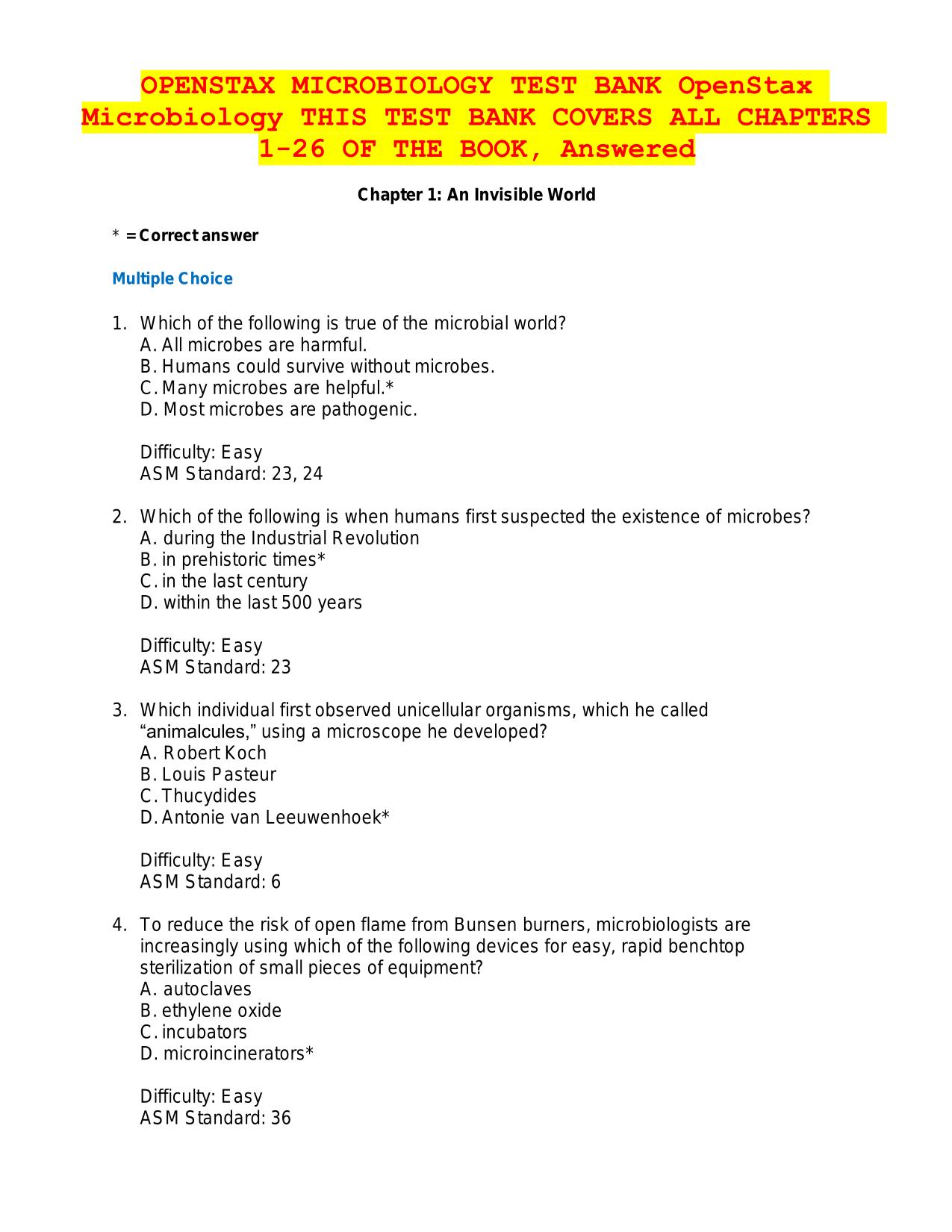
Test Bank For Microbiology by OpenStax 978-1938168147 All Chapter 1-26 Latest 2025/2026 Multiple Choice 1. Which of the following is true of the microbial world? A. All microbes are harmful. B. Humans could survive without microbes. C. Many microbes ...
After purchase, you get:
✅ Instant PDF Download
✅ Verified answer explanations
✅ Refund if not Satisfied
✅ Prepared for 2025/2026 test cycle
Overview
Each topic is broken down into manageable parts so learners can reinforce difficult areas without feeling overwhelmed. Complex subjects become much more approachable when they're divided into bite-sized pieces you can tackle one at a time. This chunking technique is perfect for busy students who can only study in short bursts throughout their day. Many learners find they make faster progress with this organized approach than with traditional, dense study materials.
Who Is This For?
Bank For Microbiology by OpenStax 978-1938168147 All Chapter 1-26 / aspirants aiming to build both conceptual knowledge and exam strategy will find this document extremely useful. Many successful candidates have used similar materials in their preparation. The thorough coverage ensures no important topics are missed. specific toward exam takers who want curated, mistake-free, and carefully formatted revision material for Bank For Microbiology by OpenStax 978-1938168147 All Chapter 1-26 /. Users appreciate the attention to detail and accuracy. The clean presentation makes studying more effective and less frustrating.
Related Keywords
Detailed Study Description
Frequently Asked Questions
Document Information
| Uploaded on: | November 1, 2025 |
| Last updated: | November 17, 2025 |
| Number of pages: | 551 |
| Written in: | 2025/2026 |
| Type: | Exam (elaborations) |
| Contains: | Questions & Answers |
| Tags: | Test Bank For Microbiology by OpenStax 978-1938168147 All Chapter 1-26 Latest 2025/2026 Multiple Choice 1. Which of the following is true of the microbial world? A. All microbes are harmful. B. Humans could survive without microbes. C. Many microbes are helpful.* D. Most microbes are pathogenic. Difficulty: Easy ASM Standard: 23, 24 2. Which of the following is when humans first suspected the existence of microbes? A. during the Industrial Revolution B. in prehistoric times* C. in the last century D. within the last 500 years Difficulty: Easy ASM Standard: 23 3. Which individual first observed unicellular organisms, which he called “animalcules,” using a microscope he developed? A. Robert Koch B. Louis Pasteur C. Thucydides D. Antonie van Leeuwenhoek* Difficulty: Easy ASM Standard: 6 4. To reduce the risk of open flame from Bunsen burners, microbiologists are increasingly using which of the following devices for easy, rapid benchtop sterilization of small pieces of equipment? A. autoclaves |
Seller Information

AdelineJean
User Reviews (0)
Exam (Elaborations)
$17.50
Add to Cart
100% satisfaction guarantee
Refund Upon dissatisfaction
Immediately available after purchase
Available in Both online and PDF
$17.50
| 0 sold
Discover More resources
Inside The Document
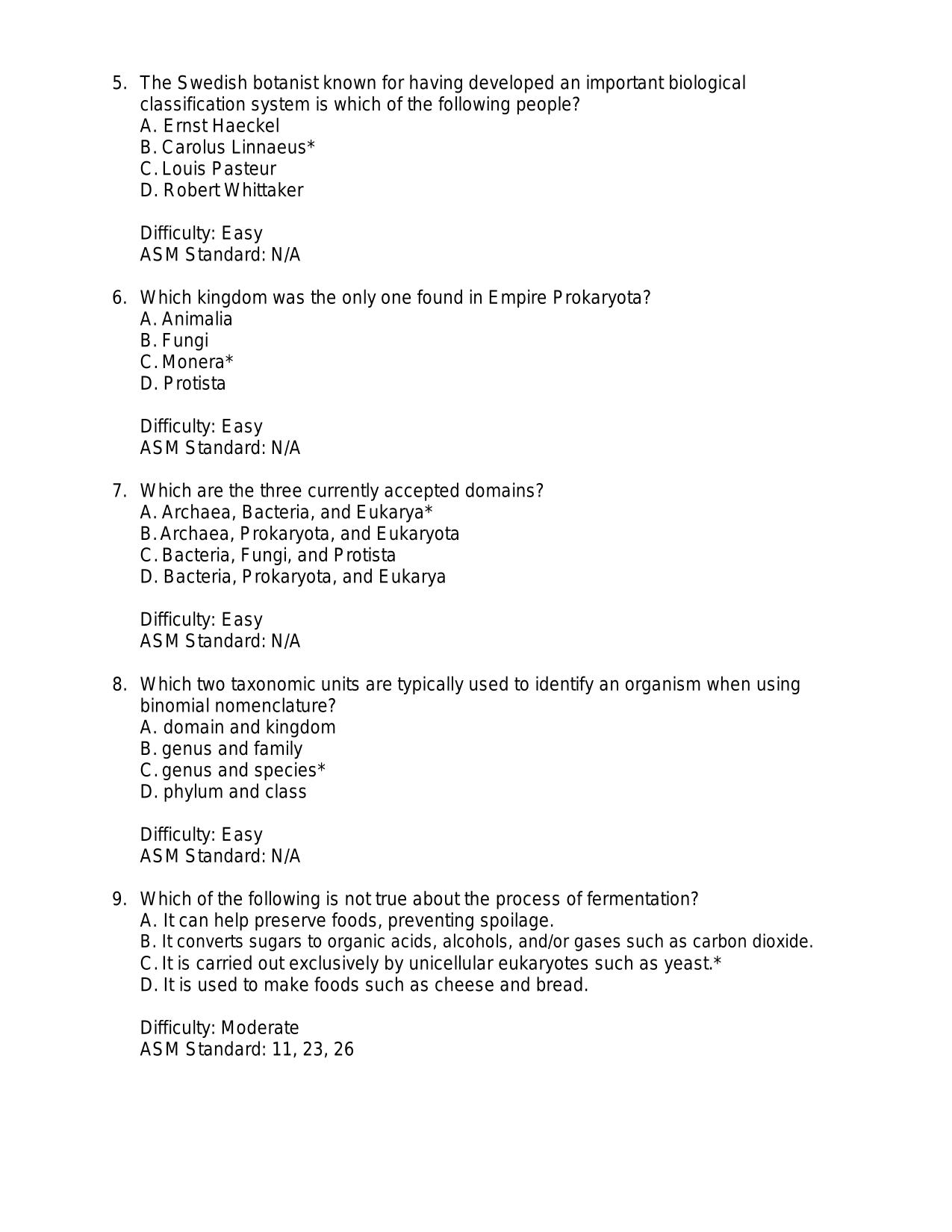
OPENSTAX MICROBIOLOGY TEST BANK OpenStax Microbiology THIS TEST BANK COVERS ALL CHAPTERS 1-26 OF THE BOOK, Answered Chapter 1: An Invisible World * = Correct answer Multiple Choice 1. Which of the following is true of the microbial world? A. All microbes are harmful. B. Humans could survive without microbes. C. Many microbes are helpful.* D. Most microbes are pathogenic. Difficulty: Easy ASM Standard: 23, 24 2. Which of the following is when humans first suspected the existence of microbes? A. during the Industrial Revolution B. in prehistoric times* C. in the last century D. within the last 500 years Difficulty: Easy ASM Standard: 23 3. Which individual first observed unicellular organisms, which he called “animalcules,” using a microscope he developed? A. Robert Koch B. Louis Pasteur C. Thucydides D. Antonie van Leeuwenhoek* Difficulty: Easy ASM Standard: 6 4. To reduce the risk of open flame from Bunsen burners, microbiologists are increasingly using which of the following devices for easy, rapid benchtop sterilization of small pieces of equipment? A. autoclaves B. ethylene oxide C. incubators D. microincinerators* Difficulty: Easy ASM Standard: 36 5. The Swedish botanist known for having developed an important biological classification system is which of the following people? A. Ernst Haeckel B. Carolus Linnaeus* C. Louis Pasteur D. Robert Whittaker Difficulty: Easy ASM Standard: N/A 6. Which kingdom was the only one found in Empire Prokaryota? A. Animalia B. Fungi C. Monera* D. Protista Difficulty: Easy ASM Standard: N/A 7. Which are the three currently accepted domains? A. Archaea, Bacteria, and Eukarya* B. Archaea, Prokaryota, and Eukaryota C. Bacteria, Fungi, and Protista D. Bacteria, Prokaryota, and Eukarya Difficulty: Easy ASM Standard: N/A 8. Which two taxonomic units are typically used to identify an organism when using binomial nomenclature? A. domain and kingdom B. genus and family C. genus and species* D. phylum and class Difficulty: Easy ASM Standard: N/A 9. Which of the following is not true about the process of fermentation? A. It can help preserve foods, preventing spoilage. B. It converts sugars to organic acids, alcohols, and/or gases such as carbon dioxide. C. It is carried out exclusively by unicellular eukaryotes such as yeast.* D. It is used to make foods such as cheese and bread. Difficulty: Moderate ASM Standard: 11, 23, 26 10. The Romans may have reduced their risk of waterborne infectious diseases by using which of the following? A. a variety of pharmaceutical products B. aqueducts and a sewer system* C. prophylactic antibiotics D. quarantine of people with leprosy Difficulty: Moderate ASM Standard: 23 11. For which of the following is Thucydides known? A. developing an effective sewer system in ancient Greece, helping to reduce levels of disease in cities B. observing microbes, using a microscope, for the first time, even distinguishing between bacteria and fungi C. proposing that disease was caused by microorganisms D. realizing that people who had been infected by the Athenian plague had immunity to reinfection* Difficulty: Moderate ASM Standard: 23, 31 12. Ernst Haeckel proposed a classification system consisting of which of the following subgroups? A. five kingdoms B. four kingdoms* C. two domains and three kingdoms D. two domains and five kingdoms Difficulty: Moderate ASM Standard: N/A 13. Viruses not included in phylogenetic trees for which of the following reasons? A. It is too difficult to observe their characteristics. B. They are acellular and nonliving.* C. They do not have any genes, which prevents genetic analysis. D. They lack a nucleus. Difficulty: Moderate ASM Standard: 5 14. Which is the best description of the primary purpose of a phylogeny? A. Phylogenies show all the alterative names for each species. B. Phylogenies show all the common names for each species. C. Phylogenies show evolutionary relatedness between organisms.* D. Phylogenies show interactions between species in a shared habitat. Difficulty: Moderate ASM Standard: 5 15. Current phylogenetic analyses include which of the following? A. information from a range of sources, including morphological, genetic, and biochemical data* B. information on visible similarities only C. information regarding how to classify organisms on the basis of external morphological characteristics and visible behaviors D. varied morphological and structural characteristics, with preference for leaving historical classifications to prevent confusion Difficulty: Moderate ASM Standard: 5 16. Diatoms are classified within which of the following domains? A. Archaea B. Bacteria C. Eukarya* D. Prokaryota Difficulty: Moderate ASM Standard: N/A 17. Horizontal gene transfer involves which of the following? A. any transfer of genes in a laboratory setting B. the transfer of genes from a virus to a bacterium or vice versa but not any other form of gene transfer C. the transfer of genes from one individual to another, including from one species to another, but not from parent to offspring* D. the transfer of genes from parent to offspring Difficulty: Moderate ASM Standard: 2, 4 18. Bacteria are generally identified to species by using which of the following? A. a combination of genetic, biochemical, and microscopic approaches* B. a combination of microscopic and physiological approaches, but not genetics C. primarily characteristics such as motility that can be visualized using microscopy D. primarily morphological characteristics of individual cells Difficulty: Moderate ASM Standard: 34, 36
CourseHero & Studypool Unlocks
Get Unlocked CourseHero and Studypool documents files instantly to your email, simply by pasting your link and clicking "Unlock Now". Learn more on how to unlock here.


Gradesity

We are here to help
Questions? Leave a message!
Newsletter
Get notified upon new uploads. Subscribe to our Newsletter.