Testbank for Wong's Nursing Care of Infants and Children 12th Edition by Hockenberry ISBN: 9780323776707
Course:
Nursing Care
Institution:
Nursing Care
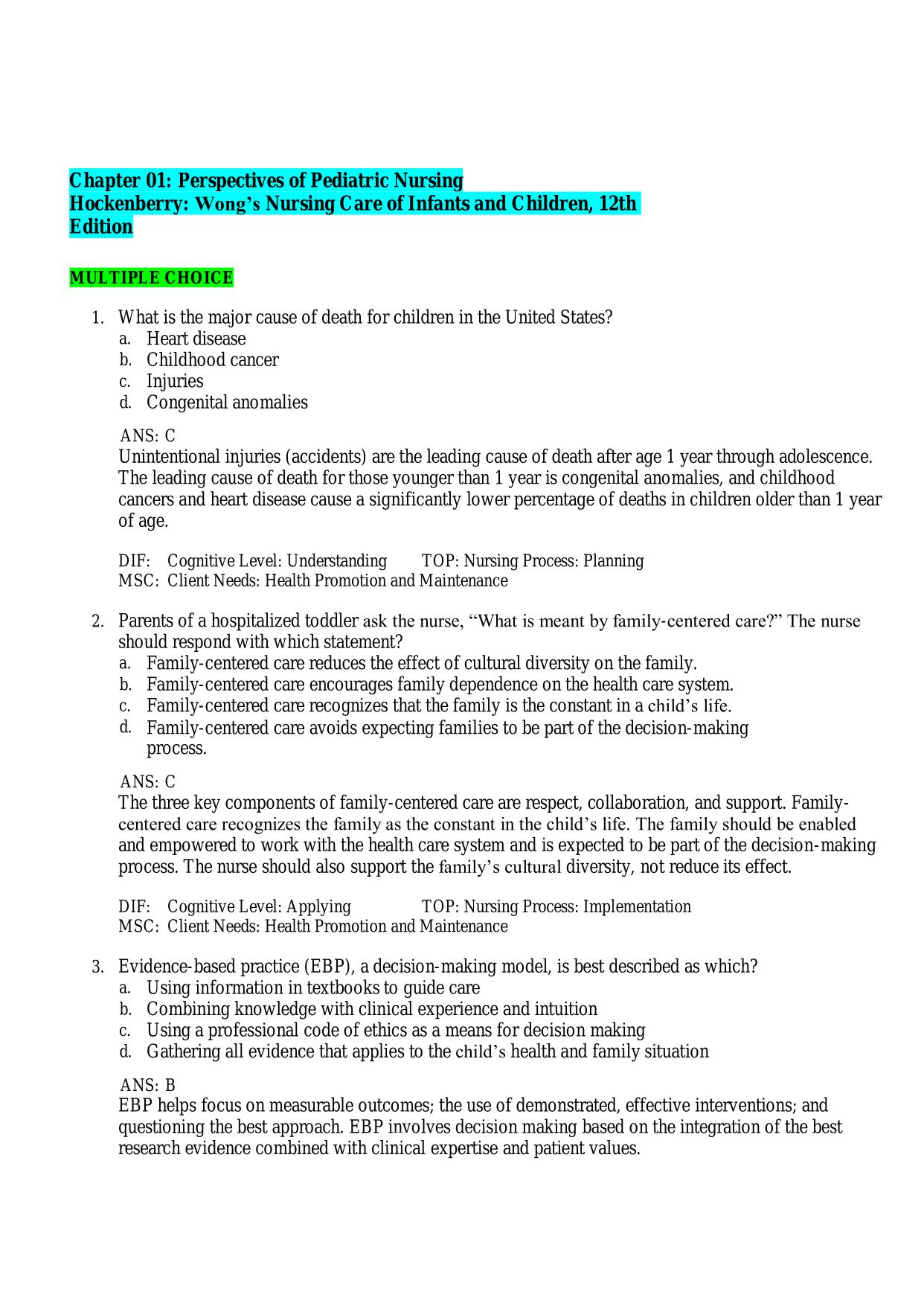
Testbank for Wong's Nursing Care of Infants and Children 12th Edition by Hockenberry ISBN: 9780323776707 Chapter 01: Perspectives of Pediatric Nursing Hockenberry: Wong’s Nursing Care of Infants and Children, 12th Edition MULTIPLE CHOICE 1. What is ...

After purchase, you get:
✅ Instant PDF Download
✅ Verified answer explanations
✅ Refund if not Satisfied
✅ Prepared for 2025/2026 test cycle
Overview
Expect a mix of multiple-choice and contextual items that test application, analysis and core knowledge areas. This variety keeps your study sessions fresh and engaging, much like the actual exam you'll be facing. Many learners mention how the scenario questions in particular help them connect dry textbook concepts to practical situations they might encounter in their careers. The different formats ensure you're prepared for whatever curveballs the exam might throw your way.
Who Is This For?
Created for exam takers seeking maximum exposure to typical Testbank questions, rationales, and scenarios. People often use it to test their readiness before the actual exam. The complete coverage ensures thorough preparation.
Related Keywords
Detailed Study Description
Frequently Asked Questions
Document Information
| Uploaded on: | November 1, 2025 |
| Last updated: | November 17, 2025 |
| Number of pages: | 293 |
| Written in: | 2025/2026 |
| Type: | Exam (elaborations) |
| Contains: | Questions & Answers |
| Tags: | Testbank for Wong's Nursing Care of Infants and Children 12th Edition by Hockenberry ISBN: 9780323776707 Chapter 01: Perspectives of Pediatric Nursing Hockenberry: Wong’s Nursing Care of Infants and Children, 12th Edition MULTIPLE CHOICE 1. What is the major cause of death for children in the United States? a. Heart disease b. Childhood cancer c. Injuries d. Congenital anomalies ANS: C Unintentional injuries (accidents) are the leading cause of death after age 1 year through adolescence. The leading cause of death for those younger than 1 year is congenital anomalies, and childhood cancers and heart disease cause a significantly lower percentage of deaths in children older than 1 year of age. DIF: Cognitive Level: Understanding TOP: Nursing Process: Planning MSC: Client Needs: Health Promotion and Maintenance 2. Parents of a hospitalized toddler ask the nurse, “What is meant by family-centered care?” The nurse should respond with which statement? a. Family-centered care reduces the effect of cultural diversity on the family. b. Family-centered care encourages family dependence on the health care system. c. Family-centered care recognizes that the family is the constant in a child’s life. d. Family-centered care avoids expecting families to be part of the decision-making process. ANS: C The three key components of family-centered care are respect, collaboration, and support. Familycentered care recognizes the family as the constant in the child’s life. The family should be enabled and empowered to work with the health care system and is expected to be part of the decision-making process. The nurse should also support the family’s cultural diversity, not reduce its effect. DIF: Cognitive Level: Applying TOP: Nursing Process: Implementation MSC: Client Needs: Health Promotion and Maintenance 3. Evidence-based practice (EBP), a decision-making mo |
Seller Information

AdelineJean
User Reviews (0)
Exam (Elaborations)
$17.00
Add to Cart
100% satisfaction guarantee
Refund Upon dissatisfaction
Immediately available after purchase
Available in Both online and PDF
$17.00
| 0 sold
Discover More resources




Inside The Document
Wong's Nursing Care of Infants and Children 12th Edition by Hockenberry Test Bank Chapter 01: Perspectives of Pediatric Nursing Hockenberry: Wong’s Nursing Care of Infants and Children, 12th Edition MULTIPLE CHOICE 1. What is the major cause of death for children in the United States? a. Heart disease b. Childhood cancer c. Injuries d. Congenital anomalies ANS: C Unintentional injuries (accidents) are the leading cause of death after age 1 year through adolescence. The leading cause of death for those younger than 1 year is congenital anomalies, and childhood cancers and heart disease cause a significantly lower percentage of deaths in children older than 1 year of age. DIF: Cognitive Level: Understanding TOP: Nursing Process: Planning MSC: Client Needs: Health Promotion and Maintenance 2. Parents of a hospitalized toddler ask the nurse, “What is meant by family-centered care?” The nurse should respond with which statement? a. Family-centered care reduces the effect of cultural diversity on the family. b. Family-centered care encourages family dependence on the health care system. c. Family-centered care recognizes that the family is the constant in a child’s life. d. Family-centered care avoids expecting families to be part of the decision-making process. ANS: C The three key components of family-centered care are respect, collaboration, and support. Familycentered care recognizes the family as the constant in the child’s life. The family should be enabled and empowered to work with the health care system and is expected to be part of the decision-making process. The nurse should also support the family’s cultural diversity, not reduce its effect. DIF: Cognitive Level: Applying TOP: Nursing Process: Implementation MSC: Client Needs: Health Promotion and Maintenance 3. Evidence-based practice (EBP), a decision-making model, is best described as which? a. Using information in textbooks to guide care b. Combining knowledge with clinical experience and intuition c. Using a professional code of ethics as a means for decision making d. Gathering all evidence that applies to the child’s health and family situation ANS: B EBP helps focus on measurable outcomes; the use of demonstrated, effective interventions; and questioning the best approach. EBP involves decision making based on the integration of the best research evidence combined with clinical expertise and patient values. Wong's Nursing Care of Infants and Children 12th Edition by Hockenberry Test Bank DIF: Cognitive Level: Remembering TOP: Nursing Process: Planning MSC: Client Needs: Safe and Effective Care Environment 4. The nurse is talking to a group of parents of school-age children at an after-school program about childhood health problems. Which statement should the nurse include in the teaching? a. Childhood obesity is the most common nutritional problem among children. b. Immunization rates are the same among children of different races and ethnicity. c. Dental caries is not a problem commonly seen in children since the introduction of fluorinated water. d. Mental health problems are typically not seen in school-age children but may be diagnosed in adolescents. ANS: A When teaching parents of school-age children about childhood health problems, the nurse should include information about childhood obesity because it is the most common problem among children and is associated with type 2 diabetes. Teaching parents about ways to prevent obesity is important to include. Immunization rates differ depending on the child’s race and ethnicity; dental caries continues to be a common chronic disease in childhood; and mental health problems are seen in children as young as school age, not just in adolescents. DIF: Cognitive Level: Applying TOP: Integrated Process: Teaching/Learning MSC: Client Needs: Health Promotion and Maintenance 5. The nurse is planning care for a hospitalized preschool-aged child. Which should the nurse plan to ensure atraumatic care? a. Limit explanation of procedures because the child is preschool aged. b. Ask that all family members leave the room when performing procedures. c. Allow the child to choose the type of juice to drink with the administration of oral medications. d. Explain that EMLA cream cannot be used for the morning lab draw because there is not time for it to be effective. ANS: C The overriding goal in providing atraumatic care is first, do no harm. Allowing the child, a choice of juice to drink when taking oral medications provides the child with a sense of control. The preschool child should be prepared before procedures, so limiting explanations of procedures would increase anxiety. The family should be allowed to stay with the child during procedures, minimizing stress. Lidocaine/prilocaine (EMLA) cream is a topical local anesthetic. The nurse should plan to use the prescribed cream in time for morning laboratory draws to minimize pain. DIF: Cognitive Level: Applying TOP: Nursing Process: Planning MSC: Client Needs: Health Promotion and Maintenance 6. Which situation denotes a nontherapeutic nurse–patient–family relationship? a. The nurse is planning to read a favorite fairy tale to a patient. b. During shift report, the nurse is criticizing parents for not visiting their child. c. The nurse is discussing with a fellow nurse the emotional draw to a certain patient. d. The nurse is working with a family to find ways to decrease the family’s dependence on health care providers. Wong's Nursing Care of Infants and Children 12th Edition by Hockenberry Test Bank ANS: B Criticizing parents for not visiting in shift report is nontherapeutic and shows an under involvement with the parents. Reading a fairy tale is a therapeutic and age-appropriate action. Discussing feelings of an emotional draw with a fellow nurse is therapeutic and shows a willingness to understand feelings. Working with parents to decrease dependence on health care providers is therapeutic and helps to empower the family. DIF: Cognitive Level: Analyzing TOP: Integrated Process: Caring MSC: Client Needs: Psychosocial Integrity 7. The nurse is aware that which age-group is at risk for childhood injury because of the cognitive characteristic of magical and egocentric thinking? a. Preschool b. Young school age c. Middle school age d. Adolescent ANS: A Preschool children have the cognitive characteristic of magical and egocentric thinking, meaning they are unable to comprehend danger to self or others. Young and middle school-aged children have transitional cognitive processes, and they may attempt dangerous acts without detailed planning but recognize danger to themselves or others. Adolescents have formal operational cognitive processes and are preoccupied with abstract thinking. DIF: Cognitive Level: Understanding TOP: Nursing Process: Assessment MSC: Client Needs: Safe and Effective Care Environment 8. The school nurse is assessing children for risk factors related to childhood injuries. Which child has the most risk factors related to childhood injury? a. Female, multiple siblings, stable home life b. Male, high activity level, stressful home life c. Male, even tempered, history of previous injuries d. Female, reacts negatively to new situations, no serious previous injuries ANS: B Boys have a preponderance for injuries over girls because of a difference in behavioral characteristics, a high activity temperament is associated with risk-taking behaviors, and stress predisposes children to increased risk taking and self-destructive behaviors. Therefore, a male child with a high activity level and living in a stressful environment has the highest number of risk factors. A girl with several siblings and a stable home life is low risk. A boy with previous injuries has two risk factors, but an even temper is not a risk factor for injuries. A girl who reacts negatively to new situations but has no previous serious illnesses has only one risk factor. DIF: Cognitive Level: Analyzing TOP: Nursing Process: Assessment MSC: Client Needs: Safe and Effective Care Environment 9. An adolescent patient wants to make decisions about treatment options, along with his parents. Which moral value is the nurse displaying when supporting the adolescent to make decisions? a. Justice
CourseHero & Studypool Unlocks
Get Unlocked CourseHero and Studypool documents files instantly to your email, simply by pasting your link and clicking "Unlock Now". Learn more on how to unlock here.






Gradesity

We are here to help
Questions? Leave a message!
Newsletter
Get notified upon new uploads. Subscribe to our Newsletter.