NR-503 Week 8 Final Exam Study Guide (Chapter 2 – 20) ACTUAL 2025/2026
Course:
NR 503
Institution:
NR 503
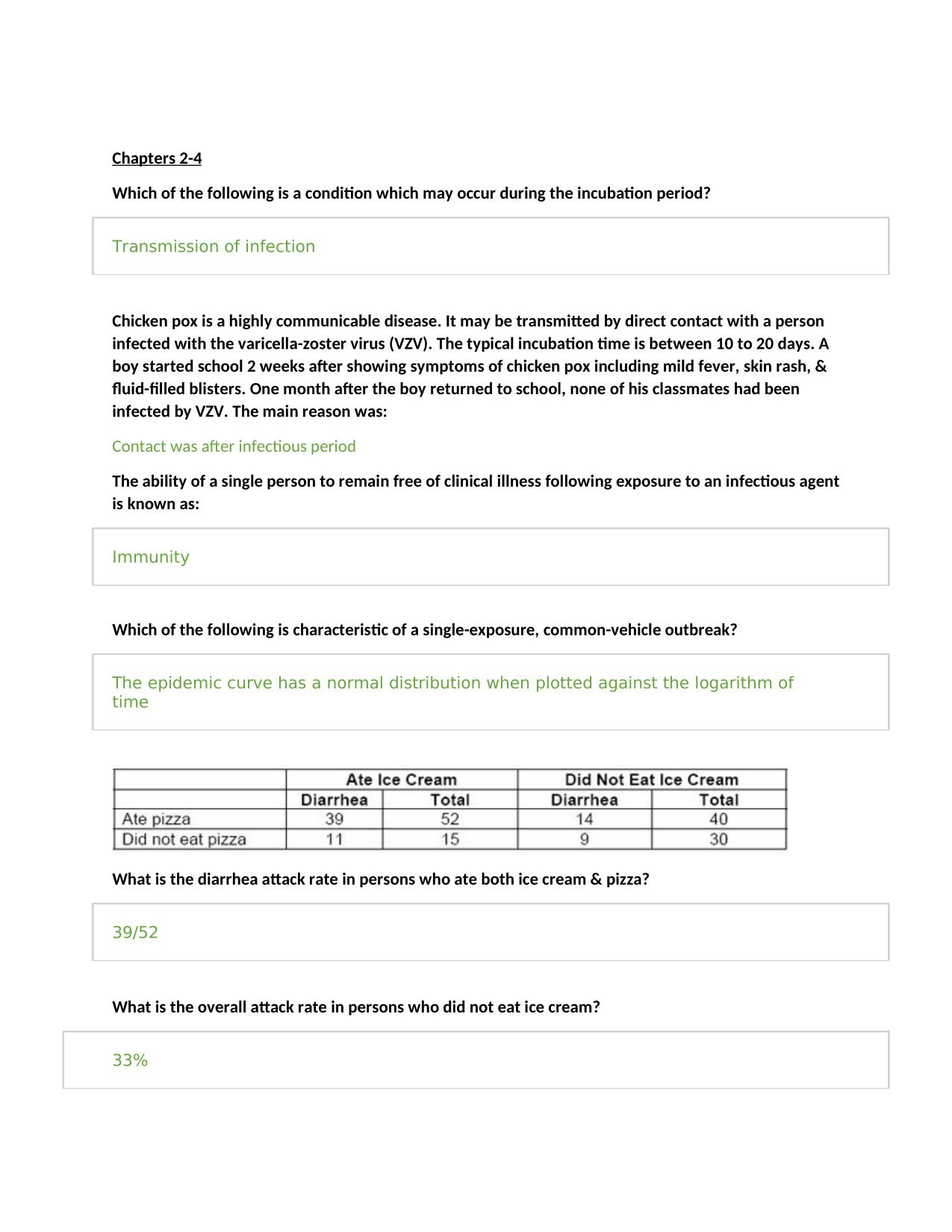
NR-503 Week 8 Final Exam Study Guide (Chapter 2 – 20). 100% Correct Questions & Answers Grade A+ Chapters 2-4 Which of the following is a condition which may occur during the incubation period? Transmission of infection Chicken pox is a highly commun...

After purchase, you get:
✅ Instant PDF Download
✅ Verified answer explanations
✅ Refund if not Satisfied
✅ Prepared for 2025/2026 test cycle
Overview
Topic clustering helps learners stay organized and review related questions together for maximum retention. Grouping similar concepts makes it easier to see connections and understand how ideas interrelate. This organized approach is particularly helpful during final review sessions when you need to refresh multiple related topics quickly. Many students find they remember information better when it's presented in meaningful clusters rather than isolation.
Who Is This For?
Effective for learners who prefer to study through real exam simulations rather than broad, unfocused summaries. This practical approach resonates with hands-on learners. The realistic practice helps build both knowledge and assurance.
Related Keywords
Detailed Study Description
Frequently Asked Questions
Document Information
| Uploaded on: | November 1, 2025 |
| Last updated: | November 29, 2025 |
| Number of pages: | 49 |
| Written in: | 2025/2026 |
| Type: | Exam (elaborations) |
| Contains: | Questions & Answers |
| Tags: | NR-503 Week 8 Final Exam Study Guide (Chapter 2 – 20). 100% Correct Questions & Answers Grade A+ Chapters 2-4 Which of the following is a condition which may occur during the incubation period? Transmission of infection Chicken pox is a highly communicable disease. It may be transmitted by direct contact with a person infected with the varicella-zoster virus (VZV). The typical incubation time is between 10 to 20 days. A boy started school 2 weeks after showing symptoms of chicken pox including mild fever, skin rash, & fluid-filled blisters. One month after the boy returned to school, none of his classmates had been infected by VZV. The main reason was: Contact was after infectious period The ability of a single person to remain free of clinical illness following exposure to an infectious agent is known as: Immunity Which of the following is characteristic of a single-exposure, common-vehicle outbreak? The epidemic curve has a normal distribution when plotted against the logarithm of time What is the diarrhea attack rate in persons who ate both ice cream & pizza? 39/52 What is the overall attack rate in persons who did not eat ice cream? 33% |
Seller Information

AdelineJean
This YouTube preview covers the main topics included in the document, such as chapters, practice questions, solved problems or summaries.
User Reviews (0)
Exam (Elaborations)
$10.00
Bundle Deal! Get all 4 docs for just $15.00
Add to Cart
100% satisfaction guarantee
Refund Upon dissatisfaction
Immediately available after purchase
Available in Both online and PDF
$10.00
| 0 sold
Discover More resources
Available in a Bundle
Inside The Document
NR-503 Week 8 Final Exam Study Guide (Chapter 2 – 20). 100% Correct Questions & Answers Grade A+. Chapters 2-4 Which of the following is a condition which may occur during the incubation period? Transmission of infection Chicken pox is a highly communicable disease. It may be transmitted by direct contact with a person infected with the varicella-zoster virus (VZV). The typical incubation time is between 10 to 20 days. A boy started school 2 weeks after showing symptoms of chicken pox including mild fever, skin rash, & fluid-filled blisters. One month after the boy returned to school, none of his classmates had been infected by VZV. The main reason was: Contact was after infectious period The ability of a single person to remain free of clinical illness following exposure to an infectious agent is known as: Immunity Which of the following is characteristic of a single-exposure, common-vehicle outbreak? The epidemic curve has a normal distribution when plotted against the logarithm of time What is the diarrhea attack rate in persons who ate both ice cream & pizza? 39/52 What is the overall attack rate in persons who did not eat ice cream? 33% Which of the food items (or combination of items) is most likely to be the infective item(s)? Ice cream only Which of the following reasons can explain why a person who did not consume the infective food item got sick? above) They were directly exposed to persons who did eat the infective food item Diarrhea is a general symptom consistent with a number of illnesses There may have been an inaccurate recall of which foods were eaten (all of the An outbreak of gastroenteritis occurred at a boarding school with a student enrollment of 846. Fiftyseven students reported symptoms including vomiting, diarrhea, nausea, & low-grade fever between 10 p.m. on September 24 & 8 p.m. on September 25. The ill students lived in dormitories that housed 723 of the students. The table below provides information on the number of students per type of residence & the number reporting illnesses consistent with the described symptoms & onset time. Calculate the attack rate among all students at the boarding school. The answer is found by dividing the total number of cases (57) by the total number of students (846). This equals 6.7%. An outbreak of gastroenteritis occurred at a boarding school with a student enrollment of 846. Fiftyseven students reported symptoms including vomiting, diarrhea, nausea, & low-grade fever between 10 p.m. on September 24 & 8 p.m. on September 25. The ill students lived in dormitories that housed 723 of the students. The table below provides information on the number of students per type of residence & the number reporting illnesses consistent with the described symptoms & onset time. Calculate the attack rates for boys & girls separately. For boys, the attack rate includes all cases (40 + 3) divided by the total number of students who are boys (380 + 46). The attack rate is 10.1%. For girls, the attack rate includes all cases (12 + 2) divided by the total number of students who are girls (343 + 77). The attack rate is 3.3%. An outbreak of gastroenteritis occurred at a boarding school with a student enrollment of 846. Fiftyseven students reported symptoms including vomiting, diarrhea, nausea, & low-grade fever between 10 p.m. on September 24 & 8 p.m. on September 25. The ill students lived in dormitories that housed 723 of the students. The table below provides information on the number of students per type of residence & the number reporting illnesses consistent with the described symptoms & onset time. What is the proportion of total cases occurring in boys? The proportion of cases occurring in boys is equal to the number of cases in boys divided by the total number of cases (43/57). This equals 75.4%. An outbreak of gastroenteritis occurred at a boarding school with a student enrollment of 846. Fiftyseven students reported symptoms including vomiting, diarrhea, nausea, & low-grade fever between 10 p.m. on September 24 & 8 p.m. on September 25. The ill students lived in dormitories that housed 723 of the students. The table below provides information on the number of students per type of residence & the number reporting illnesses consistent with the described symptoms & onset time. What is the proportion of total cases occurring in students who live in dormitories? The proportion of cases occurring in dormitory residents is equal to the number of cases in residents divided by the total number of cases (52/57). This equals 91.2%. An outbreak of gastroenteritis occurred at a boarding school with a student enrollment of 846. Fiftyseven students reported symptoms including vomiting, diarrhea, nausea, & low-grade fever between 10 p.m. on September 24 & 8 p.m. on September 25. The ill students lived in dormitories that housed 723 of the students. The table below provides information on the number of students per type of residence & the number reporting illnesses consistent with the described symptoms & onset time. Which proportion is more informative for the purpose of the outbreak investigation? Both proportions are useful. Dormitory residents account for over 90% of the cases indicating an outbreak of an infectious agent that was transmitted at the school. Furthermore, over 75% of the cases were boys indicating that the responsible agent was more likely to have been transmitted in the boys’ dormitory. A group of researchers are interested in conducting a clinical trial to determine whether a new cholesterol-lowering agent was useful in preventing coronary heart disease (CHD). They identified 12,327 potential participants for the trial. At the initial clinical exam, 309 were discovered to have CHD. The remaining subjects entered the trial & were divided equally into the treatment & placebo groups. Of those in the treatment group, 505 developed CHD after 5 years of follow-up while 477 developed CHD during the same period in the placebo group. What was the prevalence of CHD at the initial exam? The prevalence of CHD at the initial exam was 309 cases of CHD divided by 12,327 participants. This equals a prevalence of 25.1 cases of CHD per 1,000 persons. A group of researchers are interested in conducting a clinical trial to determine whether a new cholesterol-lowering agent was useful in preventing coronary heart disease (CHD). They identified 12,327 potential participants for the trial. At the initial clinical exam, 309 were discovered to have CHD. The remaining subjects entered the trial & were divided equally into the treatment & placebo groups. Of those in the treatment group, 505 developed CHD after 5 years of follow-up while 477 developed CHD during the same period in the placebo group. What was the incidence of CHD during the 5-year study?
CourseHero & Studypool Unlocks
Get Unlocked CourseHero and Studypool documents files instantly to your email, simply by pasting your link and clicking "Unlock Now". Learn more on how to unlock here.





Gradesity

We are here to help
Questions? Leave a message!
Newsletter
Get notified upon new uploads. Subscribe to our Newsletter.